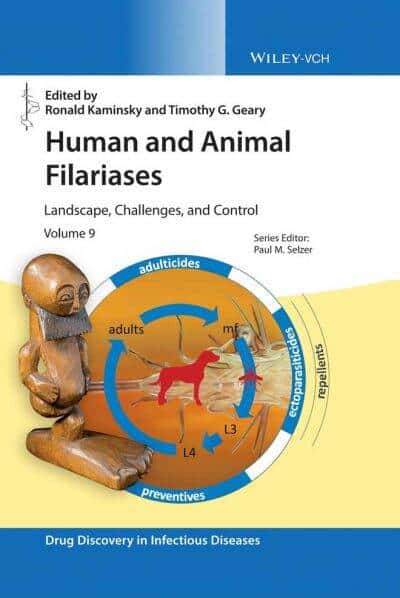
Human and Animal Filariases, Landscape, Challenges, and Control
By Ronald Kaminsky, Timothy G. Geary and Paul M. Selzer
Human and Animal Filariases, Landscape, Challenges, and Control PDF. Filariae are a family of parasitic worms which infect animals and humans, causing severe diseases such as elephantiasis (lymphatic filariasis) and river blindness (onchocerciasis) in humans, as well as heartworm disease (dirofilariasis) in dogs and cats. While the human diseases are rarely fatal, the blindness and disfiguration resulting from these infections constitute a severe burden for the affected individuals and to the healthcare systems in many tropical countries. In 2017, the World Health Organization classified several filariases as neglected tropical diseases and announced a new program seeking to eradicate these infections, which has in turn sparked a new push to develop antifilarial drugs.
Considering the current and future import of this topic, Human and Animal Filariases takes a comprehensive look at infections by filarial parasites in humans and in animals. It begins by reviewing the current state of diagnosis and chemotherapy, before addressing the increasing resistance to available antifilarial drugs. This is followed by strategies and approaches for the discovery of novel drugs and finally by looking at alternative and supplementary approaches to combat the parasites, including vector control and vaccination.
Human and Animal Filariases readers will find:
A comprehensive approach that integrates current chemotherapy with recent advances in antifilarial drug discovery
Practical information on assay development, target validation, and required drug product profiles
Insights from global experts from leading academic institutions as well as from pharma and healthcare companies
Human and Animal Filariases is a unique reference for parasitologists, veterinarians, as well as professionals in the pharmaceutical industry and in public health agencies.









![Ettinger’s Textbook of Veterinary Internal Medicine 9th Edition [True PDF+Videos]](https://www.vet-ebooks.com/wp-content/uploads/2024/10/ettingers-textbook-of-veterinary-internal-medicine-9th-edition-100x70.jpg "Ettinger’s Textbook of Veterinary Internal Medicine 9th Edition [PDF+Videos]")