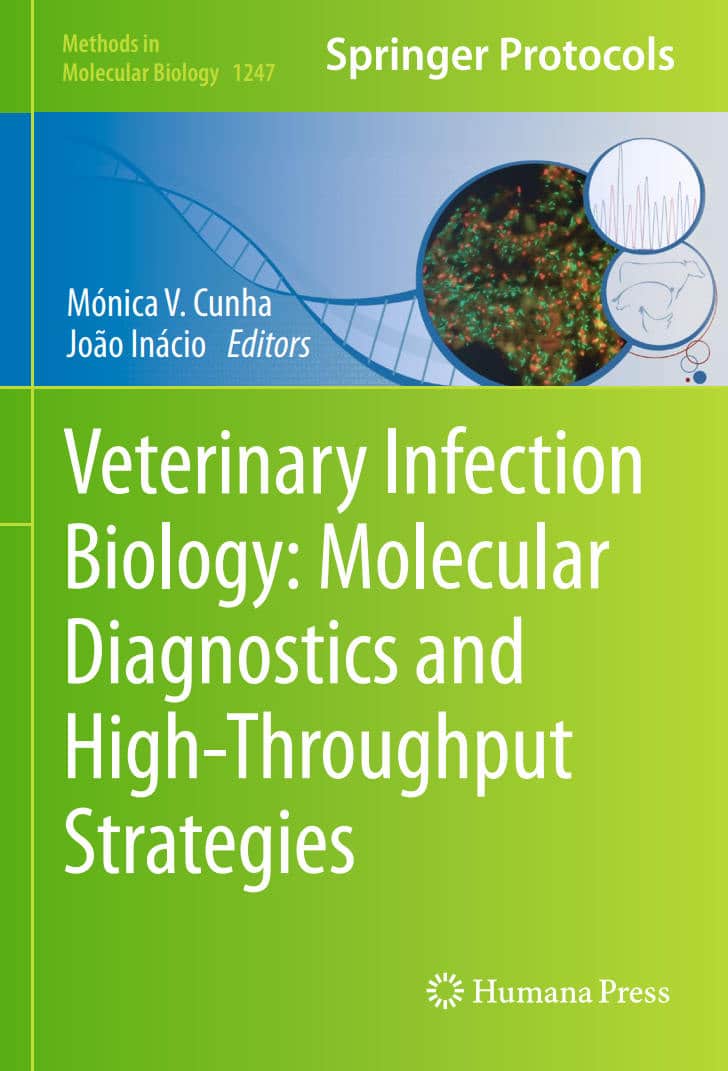
By Mónica V. Cunha and João Inácio
Veterinary Infection Biology: Molecular Diagnostics and High-Throughput Strategies provides an overview of molecular biology tools for pathogen detection and characterization. Focusing on biobanking, biosafety, good laboratory practices, biological specimen collection and processing, quality assurance and control, validation of molecular diagnostic assays for veterinary use; molecular detection and identification of animal pathogens using a wide range of established techniques and covering, also, emerging diagnosis approaches; genotyping tools for assessing the genetic landscape and epidemiology of pathogens; and integrative omics and high-throughput technologies as powerful research tools. Written in the highly successful Methods in Molecular Biology series format, chapters include introductions to their respective topics, lists of the necessary materials and reagents, step-by-step, readily reproducible laboratory protocols, and key tips on troubleshooting and avoiding known pitfalls.
Authoritative and practical, Veterinary Infection Biology: Molecular Diagnostics and High-Throughput Strategies aids scientists in continuing to study a broad range of molecular approaches, from simple and affordable to emerging and sophisticate.
Features
Features:
- Includes cutting-edge methods and protocols
- Provides step-by-step detail essential for reproducible results
- Contains key notes and implementation advice from the experts
Table of Contents
- PART I – Introducing Nucleic Acid Testing in the Veterinary Laboratory
- Overview and Challenges of Molecular Technologies in the Veterinary Microbiology Laboratory
- Significance and Integration of Molecular Diagnostics in the Framework of Veterinary Practice
- Biosafety Principles and Practices for the Veterinary Diagnostic Laboratory
- Veterinary Biobank Facility: Development and Management for Diagnostic and Research Purposes
- Biological Specimen Collection and Processing for Molecular Analysis
- Validation of Molecular Diagnostic Assays and Quality Assurance and Control in the Veterinary Laboratory
- PART II – Molecular Detection and Identification of Animal Pathogens in Laboratorial Settings
- Molecular Approaches to Recognize Relevant and Emerging Infectious Diseases in Animals
- Real-Time Reverse Transcriptase PCR for the Detection of Bluetongue Virus
- Nested and Multiplex Real-Time PCR Using Dual-Labeled Probes: Detecting and Discriminating Mycobacterium tuberculosis Complex Members in Cultures and Animal Tissues
- A Real-Time PCR Assay for the Diagnosis of Gastrointestinal Nematode Infections of Small Ruminants
- Improved Detection of Mycobacterium bovis in Bovine Tissues Using Immunomagnetic Separation Approaches
- Detection of Fish Pathogens by Loop-Mediated Isothermal Amplification (LAMP) Technique
- Direct Detection of Theileria annulata in Bovine Blood Samples Using Standard and Isothermal DNA Amplification Approaches
- Reverse Line Blot Hybridization with Species-Specific Oligonucleotide Probes: Application to Piroplasm Detection
- DNA Microarray-Based Detection of Multiple Pathogens: Mycoplasma spp. and Chlamydia spp.
- In Situ Hybridization with Labeled Probes: Assessment of African Swine Fever Virus in Formalin-Fixed Paraffin-Embedded Tissues
- Fluorescence In Situ Hybridization for the Tissue Detection of Bacterial Pathogens Associated with Porcine Infections
- Identification of Animal Pasteurellaceae by MALDI-TOF Mass Spectrometry
- Gold Nanoparticles as a Potential Tool for Diagnosis of Fish Diseases
- Nucleic-Acid Testing, New Platforms and Nanotechnology for Point-of-Decision Diagnosis of Animal Pathogens
- PART III – Molecular Profiling of Veterinary Relevant Microbial Pathogens
- Molecular Typing Tools: From Pattern Recognition to Genome-Based Algorithms
- Characterization of Campylobacter jejuni and Campylobacter coli Genotypes in Poultry Flocks by Restriction Fragment Length Polymorphism (RFLP) Analysis
- Pulsed-Field Gel Electrophoresis (PFGE): Application in Population Structure Studies of Bovine Mastitis-Causing Streptococci
- Multiple-Locus Variable-Number Tandem Repeat (VNTR) Analysis (MLVA) Using Multiplex PCR and Multicolor Capillary Electrophoresis: Application to the Genotyping of Brucella Species
- Multilocus Sequence Typing (MLST): Markers for the Traceability of Pathogenic Leptospira Strains
- Single-Nucleotide Polymorphism Discrimination Using High-Resolution Melting Analysis for the Genotyping of Bacillus anthracis
- Clustered Regularly Interspaced Short Palindromic Repeats (CRISPRs) Analysis of Members of the Mycobacterium tuberculosis Complex
- Rapid Microarray-Based Genotyping of Chlamydia spp. Strains from Clinical Tissue Samples
- Multiplexed Genotyping of Bacillus anthracis by Luminex xMap Suspension Array
- PART IV – Integrative Omics and High-Throughput Platforms
- Next-Generation Sequencing in Veterinary Medicine
- Impact of Next-Generation Technologies on Exploring Socioeconomically Important Parasites and Developing New Interventions
- Functional Genomics of Tick Vectors Challenged with the Cattle Parasite Babesia bigemina
- Metagenomic Approaches to Disclose Disease-Associated Pathogens: Detection of Viral Pathogens in Honeybees
- Proteomics Characterization of Tick-Host-Pathogen Interactions
- Index









![Ettinger’s Textbook of Veterinary Internal Medicine 9th Edition [True PDF+Videos]](https://www.vet-ebooks.com/wp-content/uploads/2024/10/ettingers-textbook-of-veterinary-internal-medicine-9th-edition-100x70.jpg "Ettinger’s Textbook of Veterinary Internal Medicine 9th Edition")