back to top

Exclusive Deal: Get Lifetime Access with One-Time Payment - Free Lifetime Updates

Never Miss a New Book
Sign Up Now
HomeOthersBiostatistics: A Guide to Design, Analysis and Discovery 2nd Edition

Biostatistics: A Guide to Design, Analysis and Discovery 2nd Edition

-

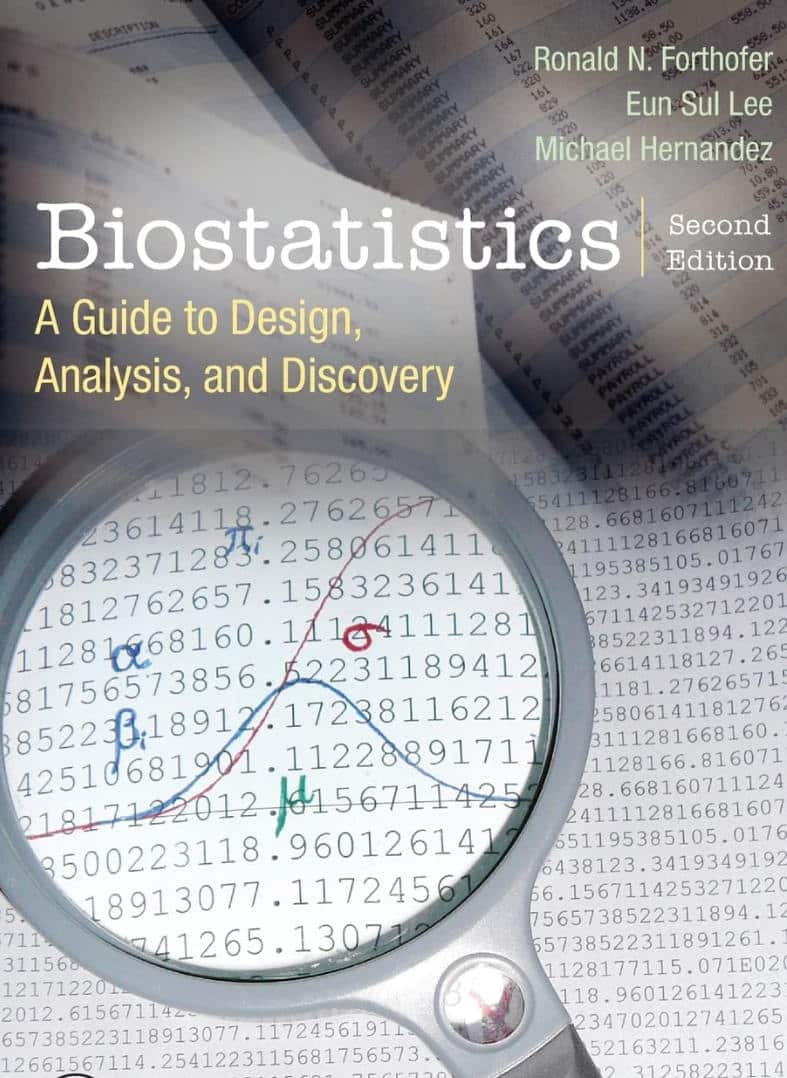
Biostatistics: A Guide To Design, Analysis And Discovery 2Nd Edition

By Ronald N. Forthofer, Eun Sul Lee and Mike Hernandez

Biostatistics: A Guide to Design, Analysis and Discovery 2nd Edition is a user-friendly guide on biostatistics, which focuses on the proper use and interpretation of statistical methods.

Biostatistics: A Guide to Design, Analysis and Discovery 2nd Edition does not require extensive background in mathematics, making it user-friendly for all students in the public health sciences field. Instead of highlighting derivations of formulas, the authors provide rationales for the formulas, allowing students to grasp a better understanding of the link between biology and statistics.

The material on life tables and survival analysis allows students to better understand the recent literature in the health field, particularly in the study of chronic disease treatment. This updated edition contains over 40% new material with modern real-life examples, exercises, and references, including new chapters on Logistic Regression, Analysis of Survey Data, and Study Designs.

The book is recommended for students in the health sciences, public health professionals, and practitioners.
Table of Contents
  • Preface
  • 1. Introduction
    • 1.1 What Is Biostatistics?
    • 1.2 Data — The Key Component of a Study
    • 1.3 Design — The Road to Relevant Data
    • 1.4 Replication — Part of the Scientific Method
    • 1.5 Applying Statistical Methods
    • Exercises
    • References
  • 2. Data and Numbers
    • 2.1 Data: Numerical Representation
    • 2.2 Observations and Variables
    • 2.3 Scales Used with Variables
    • 2.4 Reliability and Validity
    • 2.5 Randomized Response Technique
    • 2.6 Common Data Problems
    • Conclusion
    • Exercises
    • References
  • 3. Descriptive Methods
    • 3.1 Introduction to Descriptive Methods
    • 3.2 Tabular and Graphical Presentation of Data
    • 3.3 Measures of Central Tendency
    • 3.4 Measures of Variability
    • 3.5 Rates and Ratios
    • 3.6 Measures of Change over Time
    • 3.7 Correlation Coefficients
    • Conclusion
    • Exercises
    • References
  • 4. Probability and Life Tables
    • 4.1 A Definition of Probability
    • 4.2 Rules for Calculating Probabilities
    • 4.3 Definitions from Epidemiology
    • 4.4 Bayes’ Theorem
    • 4.5 Probability in Sampling
    • 4.6 Estimating Probabilities by Simulation
    • 4.7 Probability and the Life Table
    • Conclusion
    • Exercises
    • References
  • 5. Probability Distributions
    • 5.1 The Binomial Distribution
    • 5.2 The Poisson Distribution
    • 5.3 The Normal Distribution
    • 5.4 The Central Limit Theorem
    • 5.5 Approximations to the Binomial and Poisson Distributions
    • Conclusion
    • Exercises
    • References
  • 6. Study Designs
    • 6.1 Design: Putting Chance to Work
    • 6.2 Sample Surveys and Experiments
    • 6.3 Sampling and Sample Designs
    • 6.4 Designed Experiments
    • 6.5 Variations in Study Designs
    • Conclusion
    • Exercises
    • References
  • 7. Interval Estimation
    • 7.1 Prediction, Confidence, and Tolerance Intervals
    • 7.2 Distribution-Free Intervals
    • 7.3 Confidence Intervals Based on the Normal Distribution
    • 7.4 Confidence Interval for Differences
    • 7.5 Confidence Interval and Sample Size
    • 7.6 Confidence Intervals for Other Measures
    • 7.7 Prediction and Tolerance Intervals Based on the Normal Distribution
    • Conclusion
    • Exercises
    • References
  • 8. Tests of Hypotheses
    • 8.1 Preliminaries in Tests of Hypotheses
    • 8.2 Testing Hypotheses about the Mean
    • 8.3 Testing Hypotheses about the Proportion and Rates
    • 8.4 Testing Hypotheses about the Variance
    • 8.5 Testing Hypotheses about the Pearson Correlation Coefficient
    • 8.6 Testing Hypotheses about the Difference of Two Means
    • 8.7 Testing Hypotheses about the Difference of Two Proportions
    • 8.8 Tests of Hypotheses and Sample Size
    • 8.9 Statistical and Practical Significance
    • Conclusion
    • Exercises
    • References
  • 9. Nonparametric Tests
    • 9.1 Why Nonparametric Tests?
    • 9.2 The Sign Test
    • 9.3 The Wilcoxon Signed Rank Test
    • 9.4 The Wilcoxon Rank Sum Test
    • 9.5 The Kruskal–Wallis Test
    • 9.6 The Friedman Test
    • Conclusion
    • Exercises
    • References
  • 10. Analysis of Categorical Data
    • 10.1 The Goodness-of-Fit Test
    • 10.2 The 2×2 Contingency Table
    • 10.3 The r×c Contingency Table
    • 10.4 Multiple 2×2 Contingency Tables
    • Conclusion
    • Exercises
    • References
  • 11. Analysis of Survival Data
    • 11.1 Data Collection in Follow-up Studies
    • 11.2 The Life-Table Method
    • 11.3 The Product-Limit Method
    • 11.4 Comparison of Two Survival Distributions
    • Conclusion
    • Exercises
    • References
  • 12. Analysis of Variance (ANOVA)
    • 12.1 Assumptions for Use of ANOVA
    • 12.2 One-Way ANOVA
    • 12.3 Multiple Comparisons
    • 12.4 Two-Way ANOVA (Randomized Block Design)
    • 12.5 Two-Way ANOVA with Interaction
    • 12.6 Linear Model Representation
    • 12.7 ANOVA with Unequal Sample Sizes
    • Conclusion
    • Exercises
    • References
  • 13. Linear Regression
    • 13.1 Simple Linear Regression
    • 13.2 Inference about the Coefficients
    • 13.3 Interval Estimation for μY|X and Y|X
    • 13.4 Multiple Linear Regression
    • Conclusion
    • Exercises
    • References
  • 14. Logistic and Proportional Hazards Regression
    • 14.1 Simple Logistic Regression
    • 14.2 Multiple Logistic Regression
    • 14.3 Ordered Logistic Regression
    • 14.4 Conditional Logistic Regression
    • 14.5 Introduction to Proportional Hazards Regression
    • Conclusion
    • Exercises
    • References
  • 15. Analysis of Survey Data
    • 15.1 Introduction to Design-Based Inference
    • 15.2 Components in Design-Based Analysis
    • 15.3 Strategies for Variance Estimation
    • 15.4 Strategies for Analysis
    • 15.5 Analytic Examples
    • Conclusion
    • Exercises
    • References
  • Appendices
    • Appendix A: Review of Basic Mathematical Concepts
    • Appendix B: Statistical Tables
    • Appendix C: Governmental Sources of Biostatistical Data
    • Appendix D: Solutions to Selected Exercises
  • Index

Get This Book

File Size 6.8 MB
File Format PDF
Download link: Free Download | Go Premium, Lifetime Deal!
Useful Links: Browse All Books | Support
Join Telegram Channel: Telegram